


71 A, Suriya Hospital, Puliyangudi, Tenkasi - 627855
Women's health changes at different stages of life, and not every concern needs the same approach. A change in your menstrual cycle, unusual bleeding, persistent period pain, pelvic discomfort, or other reproductive health symptoms may sometimes be temporary. But when a problem keeps returning or starts affecting your daily life, understanding the reason is important.
At Surya Hospital in Puliyangudi, women can seek gynecology care for menstrual and reproductive health concerns. The focus is on understanding the individual problem, identifying when further evaluation is needed, and choosing an appropriate treatment or follow-up plan based on the woman’s symptoms and health needs.
Gynecology care is not only about treating a particular disease. It also gives women an opportunity to discuss changes they may have noticed and receive appropriate medical guidance instead of trying to manage persistent symptoms on their own.
Women's wellness and gynecology care covers a broad range of concerns related to the female reproductive system, menstrual health, hormonal changes and general gynecological well-being.
The same symptom can have different causes in different women. For example, irregular periods may be associated with hormonal changes, stress, changes in body weight, thyroid-related problems, pregnancy, certain medicines or PCOS. This is why an individual assessment is more useful than assuming a diagnosis from one symptom.
Your menstrual cycle can provide useful information about your overall reproductive health. While some variation from one cycle to another can happen, a persistent change in your usual pattern deserves attention.
Keeping a simple record of your periods can help you and your gynecologist understand whether there has been a genuine change in your cycle.
An irregular period can mean that your cycle is repeatedly shorter, longer or unpredictable compared with your usual pattern.
Occasional variation may not necessarily indicate a health problem. However, if irregularity continues or becomes a recurring concern, it is worth discussing with a gynecologist.
There can be several possible reasons, so the appropriate evaluation depends on your age, symptoms, medical history and reproductive circumstances.
Some women experience menstrual bleeding that is unusually heavy or lasts longer than their normal periods.
Heavy bleeding can become particularly important when it affects daily activities or is accompanied by symptoms such as tiredness, weakness or dizziness.
The reason for heavy bleeding is not always the same. Hormonal changes and certain gynecological conditions can contribute, among other possible causes. Treatment therefore depends on identifying the likely cause rather than treating every case in the same way.
Period pain is common, but severe or worsening pain should not simply be dismissed as something a woman has to tolerate.
If menstrual pain regularly affects your ability to work, study, sleep, exercise or carry out normal activities, a gynecological consultation can help determine whether further assessment is needed.
Persistent pelvic pain may sometimes have causes beyond ordinary menstrual cramps, so describing the location, timing and severity of the pain can be useful during consultation.
A period may occasionally be delayed or missed. Pregnancy is one possible reason, while hormonal changes, stress, significant changes in weight or exercise, medicines and other health conditions can also influence menstrual cycles.
If periods continue to be absent without a clear explanation, medical evaluation can help determine what may be contributing to the change.
You do not necessarily need medical attention for every small change in your cycle. However, a consultation is worth considering when a menstrual problem is persistent, unusual for you, or interfering with your everyday life.
One important point is that irregular periods do not automatically mean PCOS or PCOD. Menstrual changes can have several possible explanations, and proper evaluation helps determine what may actually be happening.
Menstrual cycles are influenced by hormonal and reproductive factors, but they can also respond to changes elsewhere in the body and in daily life.
This is why two women with apparently similar menstrual symptoms may require completely different evaluations or treatments.
A gynecologist will consider the pattern of symptoms rather than one symptom in isolation.
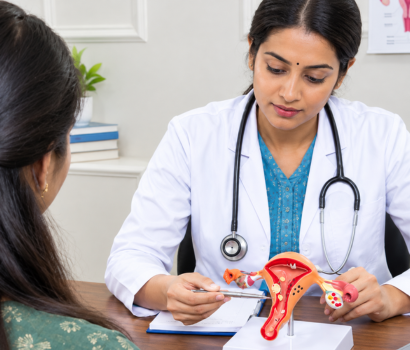

A consultation usually begins with a conversation about the concern that brought you to the doctor.
You may be asked about:
Your doctor may ask when your last period occurred, how regularly your cycles usually happen, how long bleeding lasts and whether anything has changed recently.
Depending on your concern, you may be asked about bleeding, pain, pelvic discomfort, acne, hair-growth changes, weight changes or other symptoms.
Previous illnesses, medicines, pregnancies, surgeries and relevant family history may be considered when assessing your symptoms.
If your symptoms require investigation, your doctor may recommend appropriate tests or imaging. The choice depends on the concern being evaluated.
Not every woman needs the same tests. Investigations should be guided by the individual clinical situation.
It can be tempting to search online for a symptom and immediately connect it with a particular condition. But many gynecological symptoms overlap.
For example, irregular periods can occur with PCOS, but PCOS is not the only possible explanation. Similarly, pelvic pain or heavy bleeding can have several potential causes.
Understanding the cause can help avoid unnecessary treatment and can also prevent a persistent problem from being overlooked.
For women seeking gynecology care in Puliyangudi or Tenkasi, the goal should therefore be more than simply controlling a symptom. It should be about understanding the concern and deciding what needs to happen next.
Gynecological health extends beyond periods. Women may have concerns related to reproductive health, hormonal changes, pelvic symptoms or other changes that they may feel uncomfortable discussing.
A women's wellness consultation provides an opportunity to discuss these concerns openly and determine whether they need treatment, further investigation or continued observation.
The right approach can also change with different stages of life. A woman’s reproductive goals, age, medical history and current symptoms all influence the type of care that may be appropriate.
Before visiting a gynecologist in Puliyangudi, make a note of your recent period dates, duration of bleeding, pain and any unusual symptoms. If you have previous scan reports, blood-test results or prescriptions related to the concern, keep them available for the consultation.
PCOS, or Polycystic Ovary Syndrome, is a hormonal condition that can affect ovulation, menstrual cycles and other aspects of a woman’s health. It does not look exactly the same in every woman. Some women mainly experience changes in their periods, while others may notice acne, increased facial or body hair, scalp hair thinning, weight-related concerns or difficulty becoming pregnant.
PCOD is another term frequently used when discussing hormonal and ovulatory concerns. Because these terms are sometimes used interchangeably in everyday conversations, women may find online information confusing. What matters most is identifying the symptoms and understanding whether there is an underlying hormonal or reproductive health concern that needs attention.
PCOS should not be diagnosed simply because periods are irregular or because an ultrasound report mentions ovarian changes. A proper assessment considers the overall clinical picture.
PCOS can present differently from one woman to another. Some women have noticeable symptoms, while others may have relatively few.
These symptoms can occur individually or in combination.
It is also possible for a woman to have menstrual irregularities without having PCOS. Similarly, acne, hair growth or weight changes by themselves are not enough to establish a diagnosis.
This is why a PCOS consultation in Puliyangudi should begin with an individual assessment rather than assuming that a particular symptom has one specific cause.
One of the reasons PCOS can lead to irregular periods is that ovulation may not occur regularly.
When ovulation becomes irregular, the menstrual cycle can also become unpredictable. Some women may have periods less frequently, while others may experience prolonged gaps between periods.
The effect can vary considerably. Your gynecologist may therefore look at your cycle history along with other symptoms before deciding whether further evaluation is required.
There isno single symptom, blood test or ultrasound scan that diagnoses PCOS in every woman.
Your doctor may recommend investigations based on your particular symptoms rather than ordering the same tests for every patient.
This distinction is important because several conditions can produce menstrual or hormonal changes that resemble PCOS.
An ultrasound may be useful during the evaluation of some women, but an ultrasound finding alone does not necessarily mean that a woman has PCOS.
Ovarian appearance can vary, and the significance of an ultrasound finding depends on the woman's age, symptoms and overall clinical assessment.
For this reason, an ultrasound report should be interpreted together with the rest of the medical information rather than used as a diagnosis by itself.
PCOS management is individualised. There is no single medicine or treatment plan that is suitable for every woman.
Treatment may therefore focus on the specific concerns that are affecting you rather than attempting to treat every possible symptom at once.
When PCOS is associated with infrequent or absent periods, your gynecologist may recommend an appropriate approach to manage the menstrual cycle.
The treatment chosen can depend on whether you are currently trying to conceive, your overall health and other individual factors.
It is better not to start hormonal medicines without medical advice simply because your periods are irregular. The appropriate treatment depends on the reason for the irregularity and your personal health circumstances.
Some women with PCOS are particularly concerned about acne, increased facial or body hair, or scalp hair thinning.
These symptoms can have different degrees of impact on each woman. Treatment may therefore be considered according to the specific symptom, its severity and the underlying hormonal picture.
A consultation can help determine whether the symptom is likely to be associated with PCOS or whether another explanation should be considered.
Lifestyle can form an important part of managing PCOS and supporting overall health.
Regular physical activity, balanced nutrition, adequate sleep and sustainable daily habits may support metabolic and reproductive well-being.
However, PCOS management should not be reduced to“lose weight and the problem will disappear.â€Women can have PCOS at different body sizes, and the appropriate approach varies between individuals.
Extreme dieting, unproven supplements or rapid weight-loss programmes are not substitutes for appropriate medical care.
The more useful goal is to develop healthy habits that are realistic enough to maintain over time.
PCOS can affect ovulation in some women and may make conception more difficult. However, a diagnosis of PCOS does not mean that pregnancy is impossible.
If you are planning a pregnancy, tell your gynecologist about your plans. The management approach can be different when fertility is a current priority.
Your doctor may consider your menstrual pattern, ovulation, medical history and other factors that can influence fertility. If conception does not occur, further fertility evaluation may be appropriate rather than assuming PCOS is the only reason.
PCOS-related concerns can change over time.
A young woman may first seek help because her periods are irregular. Later, she may be more concerned about skin or hair symptoms, fertility or maintaining overall metabolic health.
The priorities of treatment can therefore change as life circumstances change.
For example, the approach for someone who is not planning pregnancy may differ from the approach for a woman actively trying to conceive.
This is one reason long-term follow-up can be useful. Your management plan can be reviewed when your symptoms or health priorities change.
For many women, PCOS is better approached as a condition that may requireongoing management rather than a one-time treatment.
Symptoms can change, and treatment may need to be adjusted over time.
Follow-up can help assess whether menstrual symptoms are improving, whether treatment remains appropriate and whether new concerns need attention.
The purpose of follow-up is not necessarily to continue medication indefinitely. It is to make sure that the management approach remains suitable for your current situation.
You do not need to wait until symptoms become severe before seeking advice.
A consultation can help distinguish between a symptom that needs monitoring and one that requires further investigation or treatment.
You can make your appointment more useful by bringing information about your recent health changes.
These details can help your gynecologist understand the pattern rather than looking at one isolated symptom.
Choosing a gynecology hospital is not only about finding treatment for a particular symptom. Women often want a place where they can discuss personal health concerns comfortably, understand why an investigation or treatment may be recommended, and know what the next step will be.
At Surya Hospital, Puliyangudi, women can seek care for menstrual problems, PCOS/PCOD-related concerns and other gynecological health needs. The approach is based on understanding the individual concern and deciding on appropriate evaluation, treatment or follow-up.
For women from Puliyangudi and surrounding areas of Tenkasi, having access to gynecology care closer to home can make it easier to seek medical advice when a problem persists rather than continuing to manage it without professional guidance.
Dr. Subbulakshmi, MBBS, F-OBG , is an Obstetrician & Gynecologist and the Chief Operating Officer of Surya Hospital, with 5+ years of experience.
Dr. Subbulakshmi provides obstetric and gynecological care at Surya Hospital. Her role in women's healthcare includes evaluating concerns according to the individual patient’s symptoms, medical history and stage of life.
Women seeking care for menstrual concerns, PCOS/PCOD-related symptoms or other gynecological problems can discuss their concerns during a consultation and understand whether further evaluation or treatment may be appropriate.
The right treatment is not necessarily the same for every woman. Factors such as age, symptoms, previous medical history and pregnancy plans can influence the approach.
Women can experience similar symptoms for very different reasons. Understanding the individual history and symptoms helps guide the next step instead of assuming one diagnosis fits everyone.
The hospital provides gynecology care for concerns including menstrual problems and PCOS/PCOD-related health issues, along with other women's health needs.
Located in Puliyangudi, Tenkasi, Surya Hospital provides a local option for women who need gynecological consultation without having to postpone care when symptoms persist.
A consultation should leave you with a better understanding of what has been identified, whether further evaluation is needed and what options may be appropriate for your situation.
You may consider scheduling an appointment if you have a menstrual or gynecological concern that is persistent, recurring or affecting your quality of life.
If you experience very heavy bleeding, severe or sudden pelvic pain, fainting, significant weakness, or other potentially urgent symptoms, seek prompt medical attention rather than waiting for a routine appointment.
71 A, Surya Hospital, 5th West Street, Karpaga Veethi, Opposite to T.N.S.T.C Bus Depot, Puliyangudi, Tenkasi - 627855
If your periods repeatedly become irregular, disappear for several months, or change significantly from your usual pattern, it is reasonable to consult a gynecologist. There can be several causes, so an evaluation can help determine what may be responsible.
No. Irregular periods can have several causes, including hormonal changes, thyroid problems, pregnancy, significant changes in weight, stress, medicines and other health conditions. PCOS is one possible cause, but it should not be assumed without appropriate assessment.
PCOS may be associated with irregular periods, infrequent ovulation, acne, increased facial or body hair, scalp hair thinning, weight-related concerns and difficulty becoming pregnant in some women. Symptoms vary from person to person.
Not necessarily. An ultrasound finding needs to be considered alongside menstrual history, symptoms, examination and other relevant information. Your gynecologist can determine whether an ultrasound is appropriate as part of your evaluation.
PCOS can be managed, but there is no single treatment suitable for every woman. Management depends on symptoms, overall health and reproductive goals. Treatment may focus on menstrual regulation, hormonal symptoms, metabolic health or fertility-related concerns.
Yes. PCOS can affect ovulation and may make conception more difficult for some women, but it does not mean pregnancy is impossible. If you are planning pregnancy, discuss this with your gynecologist so that the management approach can be tailored to your reproductive goals.
If period pain is severe, worsening or regularly interferes with your work, studies, sleep or daily activities, it is worth discussing with a gynecologist. Persistent pain may sometimes have causes that need further evaluation.
Bring previous medical reports, scan or blood-test results related to your concern, a list of current medicines and details of your recent menstrual cycles. A simple record of period dates and symptoms can also be useful.
No. PCOS affects women differently. Treatment may depend on symptoms, age, overall health and whether pregnancy is currently being planned. Your doctor can recommend an approach based on your individual situation.
Women can consult the gynecology team at Surya Hospital, 71 A, Surya Hospital, 5th West Street, Karpaga Veethi, Opposite to T.N.S.T.C Bus Depot, Puliyangudi, Tenkasi - 627855.
Persistent menstrual or hormonal concerns are worth discussing rather than trying to diagnose them yourself.
If you are looking for women's wellness and gynecology care in Puliyangudi, Tenkasi, Surya Hospital provides a local setting to discuss menstrual problems, PCOS/PCOD-related concerns and other gynecological health needs.
Call Surya Hospital to discuss your concern and book an appointment with the gynecology specialist.